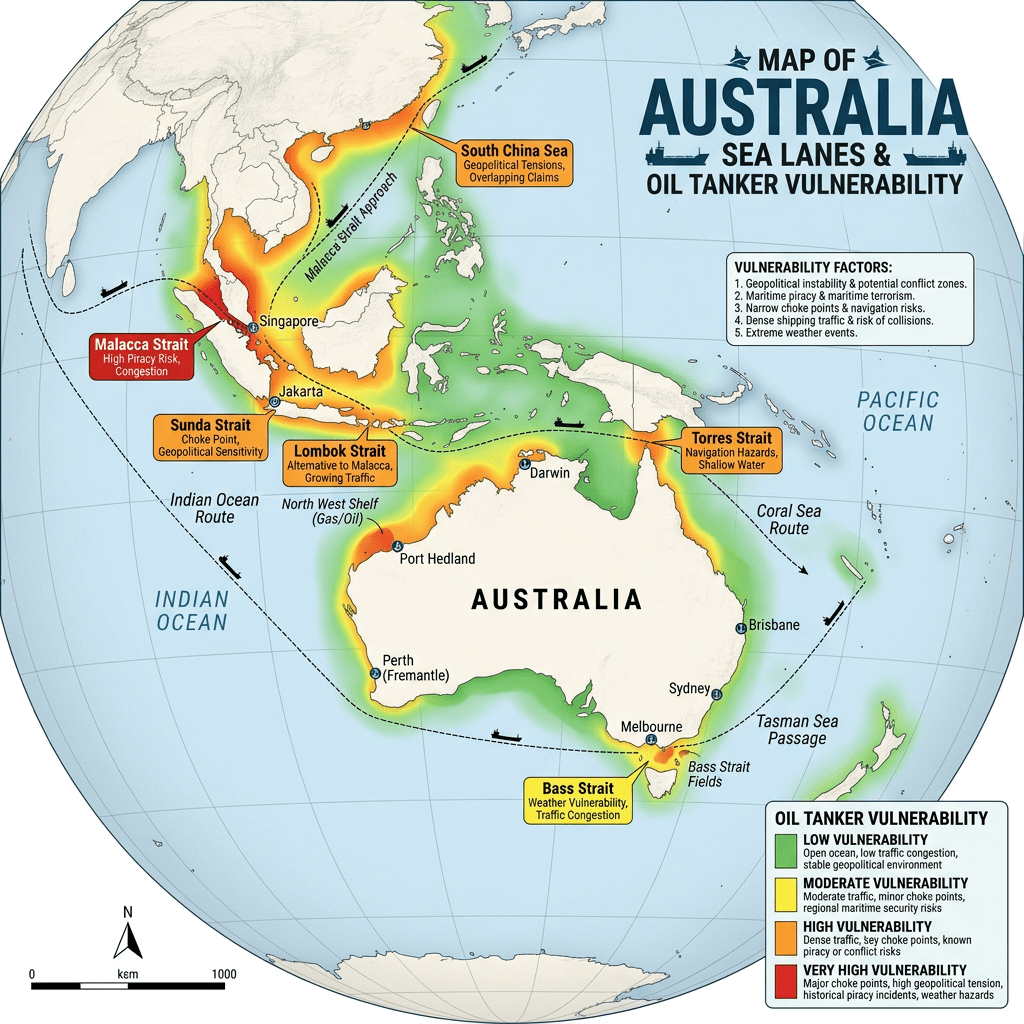
Nothing really has changed since I wrote this back in mid April. For more than a decade now Australia’s strategic direction and geo-political position have been fragile, vulnerable and in need of a fundamental rethink – to say the least. To use a popular current meme – “we can’t hope our way out of this”. The piece below first appeared in the Queensland Country Life on 23 April 2026. The graphic is AI generated and is intended only as general illustration.
The Iran War has shaken Australians into the startling realisation we live on a large island with oceans between us and the trading partners we depend on for our economic survival.
It’s been long known that locking up 20% of the world’s oil, gas and petrochemical supplies behind a closed Strait of Hormuz would massively disrupt the global economy.
And yet what has the ‘complacent country’ done with that knowledge?
Four refineries closed, one left working and one now fire damaged, and fuel reserves, which were at 90 days last in 2012, have run down to less than a month under both Coalition and Labor.
And with the exception of Queensland, the states also have been asleep at the wheel in supporting the development of onshore oil and gas.
The government says it would cost $20 billion to restore the reserve to 90 days – seemingly a worthwhile investment, given the excise rebate will cost $2.3 billion over just three short months.
Predictably, recent political points scoring has focused on restoring our ‘sovereign capabilities’ in crucial parts of the economy, while others have argued for the “patriot” economics of Australia first.
Tilting at ideological windmills and populist whistling though will not dig Australia out of the hole in which it now finds itself.
Economic and energy resilience can be strengthened without returning to the old days when everything cost more and our great export primary industries were disadvantaged because Australia hid behind a protectionist tariff wall.
Freed of tribal politics, energy policy simply should be technology agnostic and be grounded on the four principles of reliability, affordability, economic efficiency and sustainability.
That means diversifying the energy mix, encouraging domestic oil and gas development, substituting biofuels where feasible, and forging ahead with further electrification of the economy with renewable and nuclear energy in play.
Australia desperately needs a bipartisan consensus on energy policy, because the climate wars and uncoordinated programs are costing us and future generations dearly.
Encouragingly, there seems to be broader agreement about the importance of investing in “sovereign capabilities” protecting essential inputs like fertilisers from supply chain disruption.
The main lesson from this most recent upheaval is that as a trading nation Australia cannot disconnect from the global economy, but we can be much smarter, proactive and strategic in managing those things our quality of life demands we cannot do without.
The days of “she’ll be right” are surely over!

