The idea of markets delivering economically and ecologically efficient outcomes in nature conservation and repair is well over half a century old.
During that time, the orthodox view has been that the environment can only be protected by law and regulation using the coercive function of government.
Yes, as a I know from my EPA days, there is a non-negotiable role for regulation in drawing the red line for unacceptable practices that degrade and destroy our natural systems.
But regulation works only if there is effective enforcement and that comes with its own costs and risks.
So, notwithstanding the best intentions of many, from the time the first EPA was established back in 1970, all the regulation in the world has not stopped an unprecedented and massive escalation of unsustainable development.
A sustainable future demands a more creative approach to reconciling environmental, economic and social interests.
It requires all the tools at our disposal, especially those that engineer innovation and incentivize stewardship.
I’ve long thought that maybe the best way to really reverse the ‘tragedy of the commons’ is to mobilise the forces of economic self-interest in the conservation and restoration of what economists call “externalities”.
In short, if we provide ways to commercialise environmental stewardship it will add substantially to global attempts to regain equilibrium between humanity and nature.
This explains my enthusiasm for collaborative public-private initiatives that have been underway in Queensland for some time.
Organisations like Queensland Trust for Nature and Eco-Markets Australia and their partners are demonstrating the utility of voluntary initiatives in ways as different as nature covenants and tradable credits derived from environmental performance.
Solutions-focused organisations are excited at the possibilities that might be delivered through the Commonwealth Government’s reform of environmental legislation recommended more than 5 years ago in the report by Graeme Samuels.
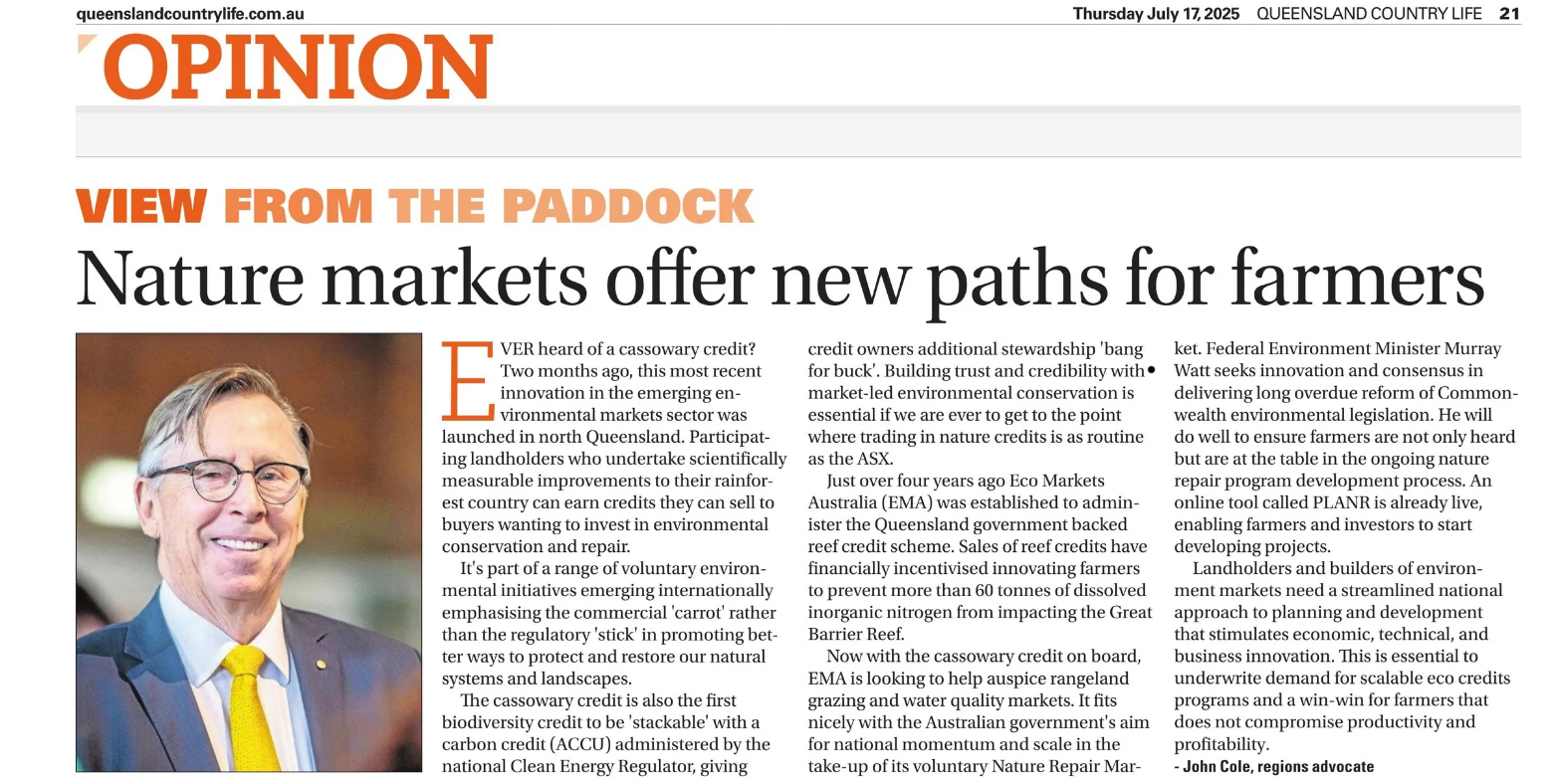
We will need a raft of strategies, tools and collaborators, including all levels of government, industry and communities to realise the targets the Federal Government has set. You can click on the image below to read a short article I wrote this week for Queensland Country Life.
 Professor John Cole